
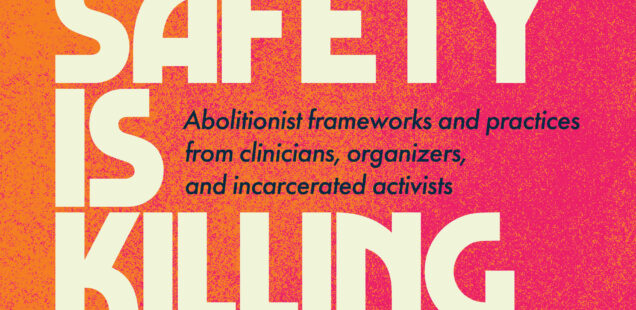
All this safety is killing us: Health justice beyond prisons, police, and borders Book Review
All This Safety Is Killing Us: Health Justice Beyond Prisons, Police, and Borders, edited by Ronica Mukerjee and Carlos Martinez (2025), challenges the assumption that prisons, border security, and policing provide protection and well-being. The collection examines how these systems disproportionately target marginalized communities and deepen health disparities. Bringing together health practitioners, academics, artists, and activists, it envisions a post-carceral society grounded in collective care. As an academic who had not previously engaged closely with abolitionist frameworks, I found it an accessible and compelling introduction.
One of the book’s strongest contributions is its healthcare lens; it strongly describes the intertwined aspects of health and the incarceration system. Additionally, connections with economic inequality, labour, migration, environmental conditions, and community life emerge throughout. I read this as a systems perspective: understanding and addressing harm requires examining the relationships among the institutions and conditions that produce it. This encouraged me to consider how improving health requires changes beyond healthcare services.
The book’s combination of scholarship, practitioner perspectives, activist accounts, and visual art also makes community present in both its content and material form. Edee Allynnah Davis’s mini-zine (pp. 16-21) particularly resonated with me as a trans person. Her account of being housed in men’s prison dormitories, experiencing unwanted voyeurism, and facing restrictions on gender-affirming items exposes the gap between policies claiming “zero tolerance” and lived experiences. It illustrates how institutions claiming to provide safety can undermine dignity and well-being, thus negatively impacting health and care. The book nevertheless left me considering how to transition from a society organized around incarceration towards one that prioritizes care. While I appreciate its emphasis on explaining existing harms and imagining alternatives, I now see an opportunity to further discuss practical change, accountability, and responses to these serious harms. My central takeaway is the importance of investing in care and community. Additionally, it is clear that the difficulty of dismantling carceral systems does not justify waiting while their harms continue. Changes in funding, policy, and institutional priorities offer opportunities for action now, especially the allocation of funding to community organizations and services. The book’s value lies in challenging readers to reconsider what safety requires and how we can build the conditions for collective well-being.
Reviewed by: Daniel Layden


Comments are closed, but trackbacks and pingbacks are open.